
Losing a tooth can affect much more than the appearance of your smile. A missing tooth may make chewing more difficult, affect the way you speak, allow neighbouring teeth to shift, and contribute to changes in the jawbone over time. Fortunately, modern dentistry offers several options for replacing missing teeth, and dental implants have become an effective long-term solution for many patients.
A dental implant replaces the root of a missing tooth and provides a stable foundation for a crown, bridge, or other dental restoration. Unlike a traditional bridge, an implant does not rely on neighbouring natural teeth for support. The Canadian Dental Association explains that implants are typically made using titanium and are placed into the jawbone, where they can integrate with the surrounding bone.
If you are considering dental implants, understanding what the treatment involves can help you make an informed decision. This guide explains how dental implants work, who may be a suitable candidate, what happens during treatment, recovery expectations, potential risks, maintenance requirements, and the questions you should ask before proceeding.
What Are Dental Implants?
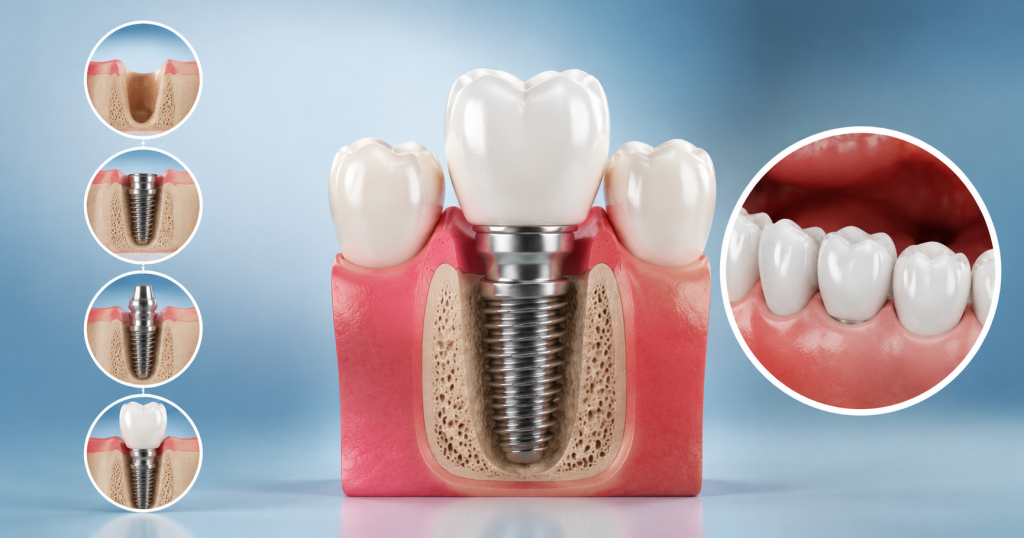
A dental implant is an artificial tooth root that is surgically placed into the jawbone. Once the implant has healed and integrated with the bone, it can support a replacement tooth called a dental crown.
A complete single-tooth implant generally consists of three main components:
- Implant: The small post placed into the jawbone to replace the missing tooth root.
- Abutment: A connector attached to the implant that supports the replacement tooth.
- Crown: The visible portion of the restoration designed to resemble a natural tooth.
Dental implants can also be used to support bridges or other restorations when several teeth are missing. This makes implant treatment suitable for a range of tooth replacement situations rather than only for individual missing teeth.
Why Do People Choose Dental Implants?
There are several ways to replace missing teeth, including conventional bridges and removable dentures. Dental implants offer a different approach because they replace the tooth root as well as the visible portion of the tooth.
One of the main advantages is stability. Because the implant is anchored within the jawbone, the replacement tooth can feel more secure than a removable restoration. Patients can generally eat, speak, and smile without having to worry about a denture moving out of position.
Dental implants can also help preserve the structure of the jaw. After a tooth is lost, the bone surrounding the missing tooth no longer receives the same stimulation from chewing and can gradually shrink. Replacing the root with an implant can help maintain the area of the jawbone around the implant.
Another benefit is that an implant-supported restoration can be designed to closely match the surrounding teeth. When properly planned and maintained, the result can look natural while restoring important dental function.
Who Is a Good Candidate for Dental Implants?
Dental implants are not automatically suitable for everyone who has a missing tooth. Your dentist needs to evaluate your teeth, gums, jawbone, general health, and specific treatment requirements before recommending an implant.
According to the Canadian Dental Association, suitable candidates generally need healthy gums and enough bone in the jaw to support the implant. When there is insufficient bone, bone grafting may sometimes be considered to increase the available bone before implant placement.
Your dentist may assess factors such as:
Jawbone Health
The implant needs adequate bone support to remain stable. Significant bone loss can make implant placement more complicated and may require additional treatment.
Gum Health
Healthy gums are important before implant treatment. Existing gum disease may need to be treated and controlled before an implant is placed.
Overall Health
Certain medical conditions, medications, and lifestyle factors can affect healing and treatment planning. Your dentist will review your health history and determine whether any additional precautions are necessary.
Oral Hygiene
Dental implants still require daily care. A patient who has difficulty maintaining good oral hygiene may have a greater risk of complications around the implant.
Smoking
Smoking can interfere with healing and may increase the risk of complications. If you smoke, discuss this openly with your dentist before treatment so that your individual risks can be assessed.
The best way to determine whether implants are appropriate is through a professional examination rather than relying on general eligibility criteria.
What Happens During a Dental Implant Consultation?
The consultation is an important part of the implant process because treatment needs to be planned around your individual anatomy and oral health.
Your dentist will examine the missing tooth area and surrounding teeth and gums. Dental X-rays and other diagnostic imaging may be recommended to evaluate the jawbone and determine where an implant could be positioned safely. The Canadian Dental Association notes that dental imaging is part of the assessment used to determine whether dental implants are appropriate.
This appointment is also the right time to ask questions and understand why a particular treatment approach has been recommended.
How Does the Dental Implant Procedure Work?
Dental implant treatment usually takes place over several stages. The exact process varies depending on the patient’s oral health, the number of missing teeth, the location of the implant, and whether additional procedures are required.
Step 1: Examination and Treatment Planning
The first stage involves a detailed assessment of your oral health. Your dentist determines whether an implant is suitable and develops a treatment plan based on the condition of your jawbone, gums, and surrounding teeth.
Step 2: Implant Placement
The implant is surgically placed into the jawbone beneath the gum tissue. This implant serves as the artificial root of the replacement tooth.
After placement, the area needs time to heal. During this stage, the implant can gradually integrate with the surrounding bone in a process known as osseointegration. The Canadian Dental Association notes that healing can take several months.
Step 3: Abutment Placement
Once the implant has adequately healed, an abutment may be attached. The abutment acts as the connector between the implant and the replacement tooth.
In some treatment situations, implant placement and abutment placement can be completed as part of the same surgical stage. Your dentist will explain which approach is appropriate for you.
Step 4: Dental Crown Placement
The final stage involves attaching a custom-made crown to the abutment. The crown is designed to restore the appearance and function of the missing tooth.
Depending on your case, several appointments may be required to ensure the restoration fits properly and works comfortably with your bite.
How Long Does Dental Implant Treatment Take?
There is no single timeline that applies to every patient. Some implant treatments can be completed relatively quickly, while others require several months.
Healing time is affected by factors such as the location of the implant, the condition of the jawbone, your individual healing response, and whether procedures such as bone grafting are necessary.
The Canadian Dental Association indicates that the implant may require several months to heal and bond with the bone before the next stages are completed.
During your consultation at Brookmere Dental Group, your dentist can provide a more realistic timeline based on your specific treatment plan.
Does Getting a Dental Implant Hurt?
Many patients are concerned about discomfort during implant treatment. The procedure is performed using local anaesthesia, so you should not feel the surgical placement in the way you might imagine.
After treatment, some tenderness, swelling, or discomfort can occur as the area heals. Your dental team will provide instructions for managing the recovery period and explain what you should and should not do following the procedure.
The amount of discomfort varies from patient to patient and can also depend on whether additional procedures are performed. If you are particularly anxious about dental treatment, discuss your concerns with your dentist before the procedure.
What Can You Eat After Dental Implant Surgery?
Your dentist will provide specific dietary instructions based on your procedure. In general, patients are advised to avoid putting unnecessary pressure on the surgical area during the initial healing period.
Soft foods may be easier to eat immediately after treatment. You may also need to avoid very hot, hard, crunchy, or sticky foods for a period recommended by your dental professional.
Do not return to your normal diet simply because the area feels better. The implant still needs time to heal, and following your dentist’s instructions can help protect the treatment area.
Also Read: Dental Implants: Things to Compare Before Choosing a Clinic
Is Bone Grafting Always Necessary?
No. Bone grafting is not required for every dental implant patient.
An implant needs adequate bone support, but some patients have sufficient bone volume for implant placement without additional treatment. If significant bone loss has occurred, however, a bone graft may be recommended to improve the available support.
Bone loss can occur after a tooth has been missing for an extended period, although the amount varies from person to person. Your dentist will use an examination and appropriate imaging to determine whether there is enough bone for your planned treatment.
If bone grafting is recommended, your dentist will explain what it involves and how it may affect your overall treatment timeline.
How Do You Care for Dental Implants?
Dental implants are not maintenance-free. Although the implant itself is artificial, the gums and surrounding tissues still need to remain healthy.
The Canadian Dental Association recommends cleaning implant-supported teeth with a toothbrush and floss and attending regular dental checkups. Your dentist can demonstrate the most appropriate cleaning techniques for your restoration.
Your daily routine should include:
- Brushing your teeth as directed by your dentist
- Cleaning around the implant carefully
- Flossing or using other recommended interdental cleaning tools
- Attending regular dental examinations and professional cleanings
- Reporting unusual swelling, bleeding, discomfort, or movement promptly
- Following any specific implant-care instructions provided by your dental team
Regular appointments are particularly important because your dentist can monitor the implant, gums, bite, and surrounding teeth over time.
Can Dental Implants Fail?
Dental implants have a high level of predictability when patients are appropriately selected and treatment is properly planned, but no dental procedure is guaranteed to be complication-free.
Potential complications can include infection, bleeding, nerve-related symptoms, injury to nearby structures, or failure of the implant to properly integrate with the bone. These complications are considered uncommon, but patients should understand that they are possible.
Problems can also develop after the implant has been successfully placed. Poor oral hygiene and inflammation around an implant can affect the surrounding tissues. This is one reason why regular dental visits and careful home care are essential.
If an implant ever feels loose or you experience persistent pain, swelling, bleeding, or other concerning symptoms, contact your dentist rather than waiting for the problem to resolve on its own.
Dental Implants vs. Bridges and Dentures
Dental implants are one of several options for replacing missing teeth. The right choice depends on your oral health, the number and location of missing teeth, your preferences, your budget, and the recommendations of your dentist.
Dental Implants
Implants replace the missing tooth root and support an individual crown, bridge, or other restoration. They are fixed in place and can provide a stable solution for tooth replacement.
Dental Bridges
A traditional bridge replaces a missing tooth by using neighbouring teeth for support. It can be an effective option in appropriate cases, particularly when the adjacent teeth are suitable for supporting the restoration.
Dentures
Dentures can replace several missing teeth or an entire arch of teeth. Depending on the type, they may be removable and can provide a practical tooth replacement option for many patients.
There is no universally best option. A dental implant may be an excellent solution for one patient while another may benefit more from a bridge or denture. A thorough dental examination is necessary to determine the most appropriate approach.
How Much Do Dental Implants Cost in Canada?
The cost of dental implants varies considerably because every treatment plan is different. The total cost can depend on the number of implants required, the type of restoration, diagnostic imaging, extractions, bone grafting, sedation, and other procedures that may be necessary.
Dental implants can have a higher initial cost than some other tooth replacement options. The Canadian Dental Association also notes that implants may cost more than other types of replacement teeth and may not be covered by every dental plan.
Rather than relying on a generic online price, ask your dentist for a detailed estimate based on your specific treatment plan. You should also confirm what is included in the quoted fee and whether your dental insurance provides any coverage.
For eligible Canadians, the Canadian Dental Care Plan may help reduce certain dental care costs, although coverage depends on the services covered under the plan and individual eligibility.
Why Choose Brookmere Dental Group for Dental Implants?
Choosing the right dental clinic for dental implants can make a significant difference in your treatment experience and results. At Brookmere Dental Group, patients receive personalized implant care supported by modern dental technology and a team focused on long-term oral health.
As a Gold Invisalign Provider, Brookmere Dental Group also has extensive experience in advanced smile and bite treatment. This expertise allows the dental team to consider both the function and appearance of your smile when planning your treatment.
From your initial consultation to implant placement and follow-up care, the team takes time to understand your needs and explain your treatment options clearly. Whether you need to replace one missing tooth or several teeth, Brookmere Dental Group provides comprehensive care in a comfortable and professional environment.
Book a consultation with Brookmere Dental Group today to find out whether dental implants are right for you.
Frequently Asked Questions About Dental Implants
Are dental implants permanent?
Dental implants are designed as a long-term tooth replacement solution, but their longevity depends on factors such as oral hygiene, gum health, bite forces, lifestyle habits, and regular professional care. The implant and the restoration also require ongoing monitoring.
Can I get a dental implant if I have bone loss?
Possibly. Some patients with bone loss may still be candidates for implants after additional treatment, such as bone grafting. Your dentist will need to evaluate your jawbone before determining whether an implant can be placed safely.
Can one dental implant replace one missing tooth?
Yes. A single dental implant can support an individual dental crown and replace one missing tooth without requiring neighbouring teeth to support the restoration.
Can dental implants replace multiple missing teeth?
Yes. Depending on your situation, multiple implants can be used to support several replacement teeth or an implant-supported bridge. Your dentist will determine how many implants are appropriate for your treatment plan.
Do dental implants look like natural teeth?
The visible crown is custom-made to resemble a natural tooth in shape, size, and colour. Proper planning and restoration can produce a natural-looking result that blends with your surrounding teeth.
How long does it take for a dental implant to heal?
Healing times vary. The Canadian Dental Association notes that the implant may take several months to heal and integrate with the surrounding bone before the final restoration is completed.
Can I eat normally with dental implants?
Once treatment has fully healed and your final restoration is in place, implant-supported teeth are designed to restore chewing function. During the healing period, however, your dentist may recommend temporary dietary restrictions.
Do dental implants require special cleaning?
Dental implants require regular cleaning, just like natural teeth. Your dentist will show you how to clean around the implant and restoration and may recommend specific flossing or interdental cleaning methods.
Are dental implants covered by dental insurance in Canada?
Coverage varies between dental plans. Dental implants may not be covered under every plan, so it is important to check your specific benefits before beginning treatment.
What happens if I do not replace a missing tooth?
Leaving a missing tooth untreated can affect chewing and may contribute to changes in the surrounding teeth and jawbone. However, the consequences vary depending on the location of the missing tooth and your individual oral health. Your dentist can explain what may happen if you delay replacement.
About The Author

Book An Appointment
Call us today at 604-373-7692 or complete the form below.